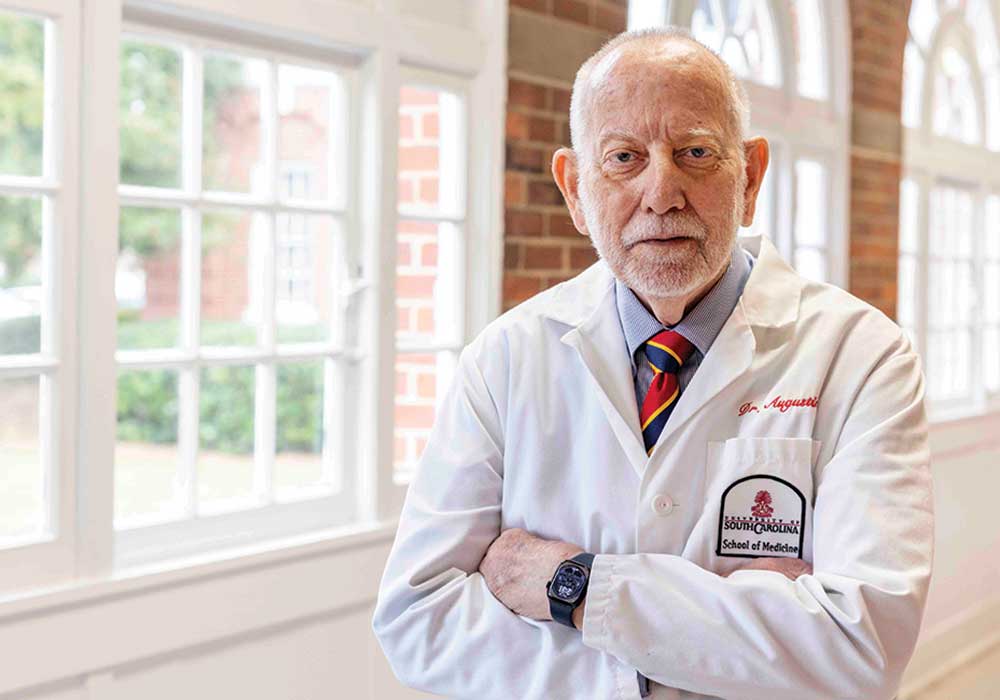
When Jim Augustine sees his personal physician, it’s also an opportunity to catch up with a former student. Same thing happens when he sees his ophthalmologist and his dermatologist.
That’s not surprising. Augustine has taught the vast majority of physicians who have graduated from the University of South Carolina’s School of Medicine in Columbia. The neuroanatomy professor was among the school’s original cadre of faculty in 1976, and even after retiring from full-time service a few years ago, he continues to teach.
“They keep asking me, and our department chair has signed me up as a temporary faculty member for another year,” says Augustine, who is fast approaching the 50-year mark at the School of Medicine. “I’ve got my health, and I’ve always said if I’m healthy, I’ll do it.”
Augustine has been a fixture at the School of Medicine for so long it’s difficult to imagine him as anything other than a professor. But more than 60 years ago, he nearly became something else: a high school dropout. Neither of his parents had high school diplomas, and when his father died, Augustine’s mother expected her son to follow family tradition.
But his teachers at Mascoutah High School in Illinois had something else in mind: they rallied around him and urged him to persevere. Augustine repaid their support with good grades and, by the end of his senior year, in 1964, a scholarship from Milliken University and a 20-hour-per-week work-study position.
Still, the first-generation college student wasn’t sure about his next step. That’s when the young biology major got a visit from two men and a brain.
“You’ve heard of Two Men and a Truck? Well, two scientists in white lab coats from St. Louis University showed up on campus with a real human brain and talked to us about studying anatomy in graduate school,” Augustine says. Their visit was part of a program sponsored by the National Institutes of Health, and Augustine was all in.
He followed the two men and their brain back to St. Louis University, where he earned a master’s in anatomy. Then he headed to the University of Alabama at Birmingham for a doctoral degree, studying with renowned neuroanatomist Elizabeth Crosby.
The connection with Crosby proved to be providential. As Augustine was wrapping up a three-year postdoctoral fellowship under her tutelage, the chairman of the anatomy department at the brand-new USC School of Medicine called Crosby seeking recommendations for someone to teach human neuroanatomy. Crosby suggested her young protégé. Augustine arrived in Columbia in 1976 to prepare for the USC medical school’s first class of students in 1977.
“I was about the same age as many of our earlier students, and it seemed we all grew up together as the school grew and prospered,” Augustine says. “I’ve always said that our school did as good a job as anybody in training medical students. We always expected them to work very hard.”
The human brain and spinal cord make for complicated subject matter, and Augustine pushed his students to a high level of rigor. They not only responded but also made their feelings known. The very first class chose him as the faculty member of the year. Over the next half century, he would receive that award six more times. “I always had a very good rapport with the students,” he says. “They were very grateful to be there, and I was grateful to have them as my students.”
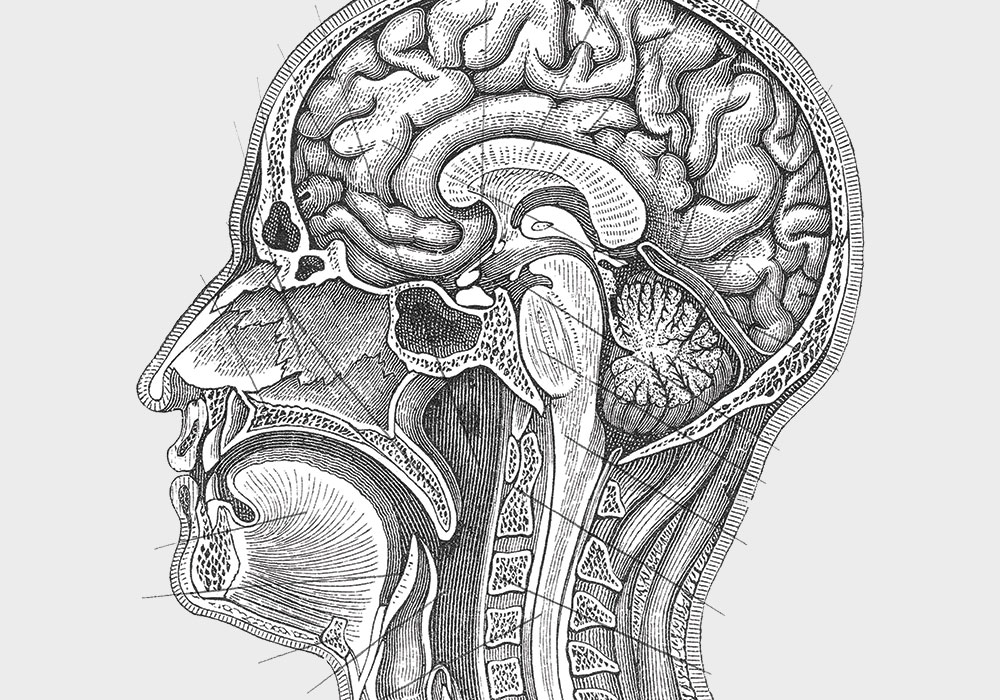
In addition to first-year medical students, Augustine has taught neuroanatomy to biomedical graduate students, including doctoral students in physical therapy and medical residents in neurology and psychiatry. Additionally, he has lectured on the neurobiology of disease, including the hippocampus and the anatomy of aging and of Alzheimer’s disease.
Augustine has also kept up with the times. When Wi-Fi emerged, USC’s School of Medicine was among the first college campuses to embrace the new technology. “You’d walk into the lecture room looking at the back of 85 laptops — that was a new experience,” he recalls. “The resources they had to learn the material above and beyond my lecturing began to take shape. It’s been a profound change.”
Along with teaching and research commitments, Augustine has served on 77 academic committees, served a term as chair of USC’s Faculty Senate and spent 10 years as the faculty ombuds for the entire USC Columbia campus, fielding inquiries and complaints and helping to settle disputes among the faculty ranks. In the early 2000s, he squeezed in medical mission trips to Haiti and helped establish and lead a Christian medical association, which later merged with the national Christian Medical and Dental Association.
Given so many professional responsibilities, it seems unlikely that Augustine would also find time to write a textbook, but he did that, too.
“Well, the first edition of Human Neuroanatomy took me 20 years to complete,” he says. “The second edition wasn’t quite so challenging, but I had an enormous amount of literature to cover, and there was an explosion of information to include after the advent of brain MRI imaging.
“In those textbooks and in my teaching, I tried to focus on what a medical student needs to know about neuroanatomy. We can’t teach them everything, but we can lay a foundation that they can build on.”