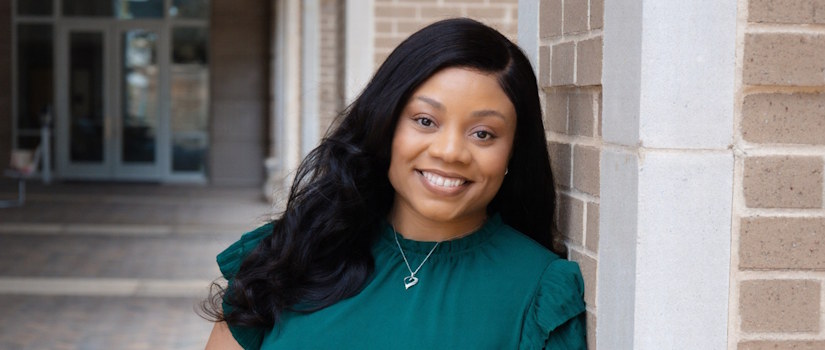
Taylor Harding’s journey began with an interest in clinical care, then broadened to focus on community-level
health. After two degrees and several years as a public health professional, she returned
to the Arnold School to bring it all together with a Doctor of Physical Therapy (DPT). Now the August graduate is perfectly positioned to provide clinical care to
a vulnerable population by focusing on women’s health.
Originally from Philadelphia, Harding says she fell in love with South Carolina the
moment she arrived to study biology as an undergraduate at SC State University. “I
knew instinctively that this was where I wanted to plant my roots and build my career,”
she says.
My Arnold School degrees have enabled me to blend high-level clinical skills with
a deep understanding of the systemic barriers my patients may face. By pairing the
‘big picture’ lens of population health with hands-on rehabilitative care, I plan
to spend my career advocating for marginalized communities and ensuring that life-changing
therapy is accessible to every individual in the state I now call home.
Taylor Harding
It was during a dental mission trip to Nicaragua her senior year that Harding’s passion
for public health was first ignited.
“I noticed a disconnect between the positive responses we received on the patient
healthy habits surveys and the reality of the community’s oral health challenges,”
she says. “This taught me a vital lesson: we cannot provide truly effective, patient-centered
care until we learn to ask the right questions for the right population, and I was
driven by a new desire to understand the cultural and social determinants that shape
a community’s wellbeing.”
Harding enrolled in the Arnold School’s Master of Public Health in Health Promotion, Education, and Behavior program – gaining experience with the SC Department of Public Health as a graduate
assistant with the agency’s newborn hearing screening program and its oral health
division. She also developed a passion for working with students as a teaching assistant,
advising and mentoring TRIO McNair Scholars. After graduating in 2017, she took on
the coordinator role with the SC Oral Health Coalition and returned to SC State University
as an adjunct professor.
“Teaching was more than just a job; it was a platform for advocacy,” Harding says.
“I spent those years instilling in my students the belief that truly helping a community
requires first understanding their unique barriers and limitations.”
Outside the classroom, Harding began to feel a new calling as she watched friends
and family members of color navigate high-risk pregnancies and difficult recoveries.
“It was a sobering reminder of the gaps that still exist in our health care system,”
she says.
Taylor Harding graduates in August with a Doctor of Physical Therapy.
Though her background had already equipped Harding to understand the systemic barriers
facing these women, she felt motivated to physically empower them as well. In 2022,
she enrolled at the Arnold School again – this time with the goal of learning how
to improve women’s health through physical therapy.
“Physical therapy – specifically pelvic health – is where my love for public health
and my passion for hands-on healing finally meet and allow me to provide specialized,
trauma-informed clinical care while continuing to advocate for the health equity every
individual deserves, especially those in vulnerable moments of their lives, while
asking the right questions,” says Harding, who plans to bridge the gaps in prenatal,
perinatal and menopausal care. “I hope to walk alongside my patients through every
stage of their lives, ensuring they feel comfortable, safe and empowered.”
She chose USC for her graduate degrees because of the university’s evident, unwavering
commitment to the state. “Whether through community outreach programs, health initiatives
or widespread advocacy, the university’s presence is felt far beyond the campus walls,”
the USC Rising Star Fellow says.
Stating that the right environment makes all the difference, Harding has also found
student comradery to be a testament to the culture that can be found at USC and the
Arnold School. She has made lifelong friends who have seen her ugly cry and made her
laugh until her stomach hurt.
Harding adds that DPT faculty like Shana Harrington, Alicia Flach, Sheri Silfies and Mandy Ward, USC School of Medicine Columbia’s Ben Hawfield and Erika Blanck, and MPH advisor
Alyssa Robillard helped her through challenging moments, validated her experiences,
reminded her not to be her own harshest critic, provided a safe space for vulnerability
and shared wisdom that cannot be found in a textbook.
“These faculty members have taught me that being a great clinician requires both a
sharp mind and a resilient heart,” Harding says. “I carry their insight with me into
every patient interaction, knowing that I am better prepared to serve my community
because they first took the time to invest in me.”
Her mentors also equipped Harding and members of her cohort to contribute during their
clinical rotations on day one. Clinical instructors consistently share how impressed
they are by the depth of the students’ knowledge as a result of the rigorous DPT curriculum
and incredible faculty.
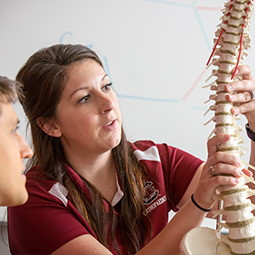
With more than 1100 hours of experience under her belt from the DPT program’s clinical
placements at MUSC Health’s Orangeburg Medical Center, Harding will wrap up her degree
– and top 1600 hours of clinical experience – with a pelvic floor specialty rotation
this summer at Atrium Health in Charlotte.
“My Arnold School degrees have enabled me to blend high-level clinical skills with
a deep understanding of the systemic barriers my patients may face,” Harding says.
“By pairing the ‘big picture’ lens of population health with hands-on rehabilitative
care, I plan to spend my career advocating for marginalized communities and ensuring
that life-changing therapy is accessible to every individual in the state I now call
home.”