“Starting over in a new country came with challenges, but it also opened doors I never
imagined,” Letizia Tamburini says of moving from the Dominican Republic to Charlotte, North Carolina eight years
ago. “Over time, I learned to embrace both parts of my identity, holding onto the
culture that shaped me while building a new sense of home in the Carolinas.”
My graduate training has given me a strong clinical foundation while reminding me
that learning doesn't stop at graduation. It has taught me how to think critically,
apply evidence-based practice, collaborate with patients and families, and approach
each person as an individual rather than a diagnosis.
Letizia Tamburini
Her multicultural upbringing also sparked a love of languages and the way people connect
with one another, leading Tamburini to develop skills in Spanish, English and Italian
and study psychology as an undergraduate at the University of North Carolina at Charlotte.
In addition to Italian, she minored in gerontology, which led her to spend time in
a retirement community through one of her courses.
“I was paired with an older adult, and we had video chats every week simply to talk,”
Tamburini says. “Those weekly talks taught me so much about aging, resilience and
the value of taking the time to truly listen to someone's life story.”
After that, she began working in the life enrichment department at another retirement
community, spending a lot of time with residents in assisted living and memory care.
She grew to love the setting – learning about each resident’s unique story and celebrating
joys and difficult moments with them. That was also where she first met a speech-language
pathologist – a USC alumna, in fact – and realized that a career in the field would
combine her passions for language, science, rehabilitation, and helping people communicate
in ways that support their independence and quality of life.
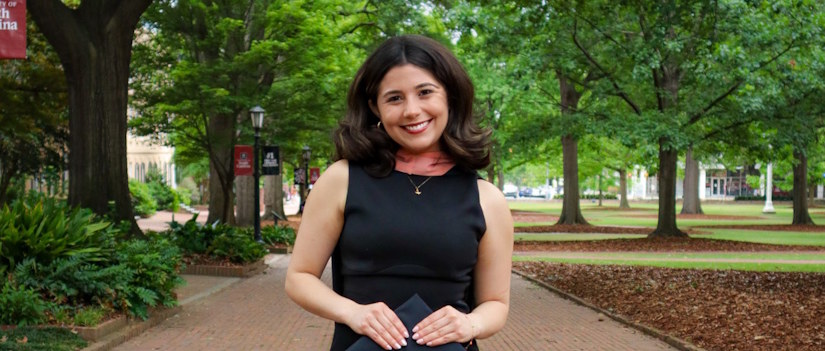
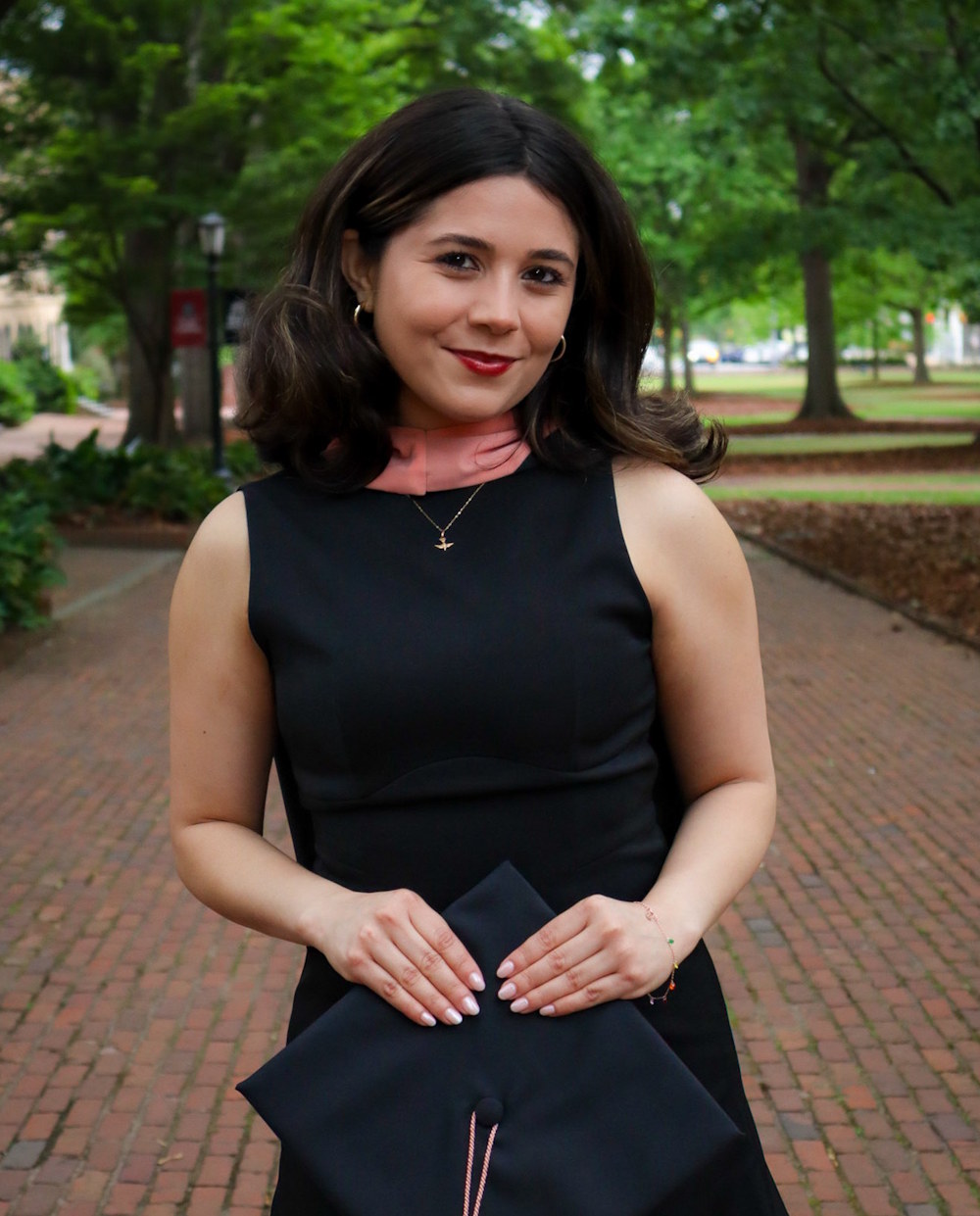
Letizia Tamburini graduates this month with a M.S. in Speech-Langauge Pathology.
When looking at graduate programs, she chose the Department of Communication Sciences and Disorders’ (COMD) M.S. in Speech-Language Pathology program because it offered a challenging academic environment and clinical experiences
across an array of settings and populations. Tamburini also appreciated that USC welcomed
students from various undergraduate backgrounds – allowing them to completed perquisite
coursework during the summer before the program began.
During her program, Tamburini developed interests in adult neurorehabilitation as
well as augmentative and alternative communication, which employs personalized strategies
and tools (e.g., picture boards, speech-generating devices). In addition to clinical
placements, she joined the department’s Neurogenic Specialization Group and served
as a graduate research assistant in COMD associate professor Lisa Fitton’s Bilingual Reading Difficulty Identification Lab.
“Every setting, diagnosis and patient has challenged me to think differently and has
taught me something new, and I enjoy helping identify approaches that best support
their everyday lives,” Tamburini says. “Beyond specific diagnoses, I am passionate
about bilingualism and providing culturally and linguistically responsive care. I
understand how closely language is connected to identity, family and culture, and
I hope to help ensure that patients and their families feel understood and supported
throughout the rehabilitation process.”
After graduating in August, the MS-Residential Outstanding Student Award winner will
complete a clinical fellowship and begin her career. While her primary interests center
around adults, she’s happy to work with every population in any setting.
“My graduate training has given me a strong clinical foundation while reminding me
that learning doesn't stop at graduation,” Tamburini says. “It has taught me how to
think critically, apply evidence-based practice, collaborate with patients and families,
and approach each person as an individual rather than a diagnosis.”
“Another lesson that has stayed with me is that aging is a universal experience, even
though no two people experience it in the same way,” she adds. “Every individual carries
a lifetime of memories, relationships and experiences that deserve to be recognized
alongside any diagnosis or treatment plan. To me, patient-centered care is not only
about clinical decisions; it is also about recognizing the person in front of you,
the life they have lived, and the life they are still living.”