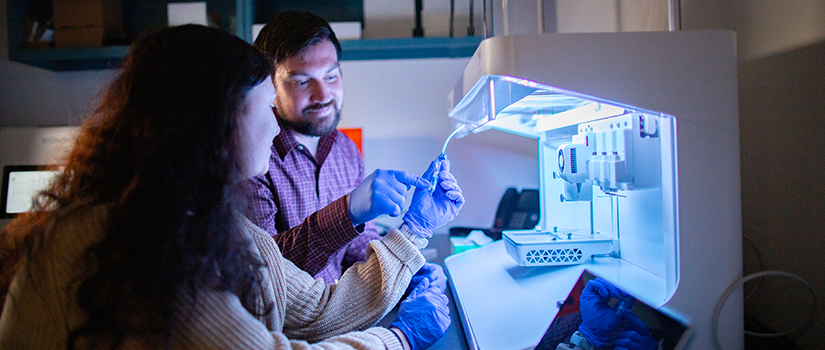
Tucked away at the Floyd School of Medicine's Instrumentation Resource Facility (IRF), three new machines are quietly positioning the University at the forefront of biomedical innovation. At first glance they may look unassuming, resembling a 3D printer that has become more prevalent across the country, but these printers don’t produce plastic prototypes. They produce groundbreaking research opportunities.
“At the most basic level, it’s about moving away from animal models into non-animal models, which is less expensive and less taxing on space for researchers,” said Instrumentation Resource Facility Director Austin Worden, Ph.D. “These systems use biomaterials and cells to create what we would term tissue-like structures. Not a direct heart, but you can print heart-like structures.”
The new bioprinters, made possible by a grant submitted by a team led by Dr. Nader Taheri Qazvini from Biomedical Engineering in the Molinaroli College of Engineering and Computing, represent a significant shift in how researchers can model disease, test drugs, and engineer tissue. Each machine has different strengths. Creating organoids, which are three-dimensional cell culture systems that mimic human organs, are one of the most promising applications.
The National Institutes of Health (NIH) has recently invested heavily in organoid research versus traditional animal-based research, signaling a shift in biomedical science. With the addition of these printers, the University, and the School of Medicine aim to position itself as a regional hub for research and innovation.
“This technology can strengthen grant applications,” Worden said. “Including access to equipment that may not be attainable for a large percentage of researchers in the United States could help advance research and potentially improve funding opportunities.”
While bioprinting is often described as next-generation medicine, it is still an emerging space. Not many universities operate multiple bioprinters within a centralized core facility. That makes the IRF’s additions both ambitious and strategic.
“With any new technology, there’s a culture shift involved, especially for labs that have relied on animal models for decades,” Worden said. “Ideally, within the first six months to a year, we’re running several quality prints per week, then gradually increasing complexity and scale as more labs adopt the technology.”
The IRF is positioning itself not just as an equipment provider, but as a collaborative partner.
“We’re not just an instrumentation core, we’re also a service core,” Worden said. “We help guide researchers through the process so they don’t need to master everything independently before using the equipment.”
That team-based approach reflects Worden’s own background in cellular and molecular biology, and the IRF staff also brings expertise in microscopy, cell culture, biofabrication, and histology, creating what Worden says is a “full-team effort.”
There is still a learning process, as the team is only a few days into working with the new equipment. But the opportunity itself is significant.
It’s not every day that you bring brand-new technology into a core facility and expand in this way. We’re fortunate to be able to do this for the facility, for the University, and hopefully for the state.
For now, the focus is simple: access.
“The key point is that we now have this technology available,” Worden said. “Researchers can come in, talk to us, see the systems and soon, use them.”