by Molly Mettler
The warnings roll on and on –– one after another, day in and day out, year over year:
- By 2050, there will be more plastic in the ocean than fish, according to The World Wildlife Foundation (October 2024).
- Among the twenty endangered animals that will be extinct by 2050 are iconic creatures that include lions, elephants, and pandas, according James Miller (March 16, 2024).
- The world will burn through its remaining “carbon budget” by 2030, according to Sarah Kaplin in her article “UN climate change report: Catastrophic warming will claim lives without action.” Washington Post, 20 March 2023.
Thud. Thud. Thud.
This is just a small sampling of the environmental warnings I have encountered over the last several years. When digested, each of these warnings bears a heavy, inescapable weight that reflects Mother Earth’s rapid environmental decline and grim future. Yet, these news headlines land on me with a thud, paralyzing me into a state of abstract contemplation instead of igniting my soul to take the action that the moment calls for.
Despite my understanding of the magnitude of this crisis, the spark within my soul to act on these issues nevertheless flickers in and out. These environmental warnings exist in my brain as bullet points in black and white text, devoid of any visual interest or beauty or connectivity to my own human experience. At a time when most of us are inundated with dopamine surging digital content, I suspect I am not alone in this response to sterile headlines regarding our very real environmental crisis. My brain is turned on, but my conscience is flat.
From the beaches and wetlands of the Lowcountry to the rolling hills of the Upstate, South Carolina is a celebration of the beauty of the natural world. We are beyond lucky to experience what South Carolina’s natural world offers. The intersection of the Pine Barrens tree frog, Triullium reliquum, the Loggerhead sea turtle, and the Carolina heelsplitter –– to name just a few of South Carolina’s endangered species –– reminds us of the need for harmony, adaptation, resilience, and interdependence in the cycles of life that bind us, living organisms, together. Sadly, even though these wildlife interactions dictate our shared South Carolina story, targeted action to ensure environmental preservation in the face of a global climate crisis is meager.
Everything changed during my sophomore year of high school. Following an unexpected encounter with a poem, my conscience was transformed from a state of environmental appreciation to one of intentional environmental action. Maya Khosla’s “Disentangling a Gray Whale” (2019) ignited a fire in me. The poem’s intimate portrayal of a seafarer’s experience witnessing a gray whale suffer from entanglement in fishing nets brought what we all read in the black-and-white text of newspapers to life: that our environment is suffering from humanity’s careless and brutal interference with nature. It was as if I experienced the soul-wrenching struggle of the whale “trapped in an endless curtain of netting.” Art, like nature, touches the soul in a way that facts and statistics cannot.
While Khosla’s poem was transformative for me, this essay is not meant to singularly praise her work; rather, it is to illustrate the transformative power that art can bring to environmental protection and preservation in South Carolina. Artistic expression emulates real life through its engagement of our mind and senses. Art engages the viewer in a way that brings them into the artistic scene –– literally making them an active participant in its portrayal. Spreading awareness and inspiring people to take action to protect and preserve our natural world is one of the only ways we can mend the damage already done. Therefore, I call on my fellow South Carolinians and our state legislators to create, collaborate, and inspire the creation of a public art initiative that focuses on the challenges South Carolina’s ecosystems face. Through environmentally focused public art initiatives such as murals, sculptures, benches or skylights, we can activate a deeper appreciation for our state’s outdoors and, in turn, foster a community that fights for all of its inhabitants – human, animal, and plant. Let us make our state our muse. Let us use our creativity to motivate change. Let us preserve South Carolina’s wild heart.
Works Cited
Khosla, Maya. "Disentangling a Gray Whale" in All the Fires of Wind and Light. Sixteen Rivers Press, 2019. Poetry Foundation, https://www.poetryfoundation.org/poems/1609471/disentangling-a-gray-whale.
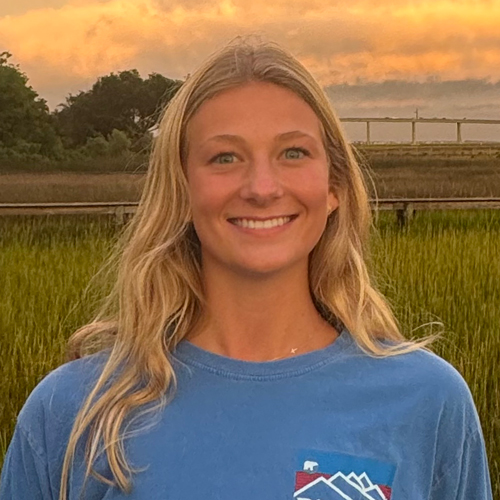
About Molly Mettler
Molly Mettler is a junior at Ashley Hall in Charleston, where Joanna Westbrook and Leslie Rowland-Ye are her English teachers. The daughter of Kate and Chris Mettler, Molly says her childhood in Charleston instilled in her a deep love and respect for coastal ecosystems. She hopes to use that passion to spread awareness about plastic pollution.